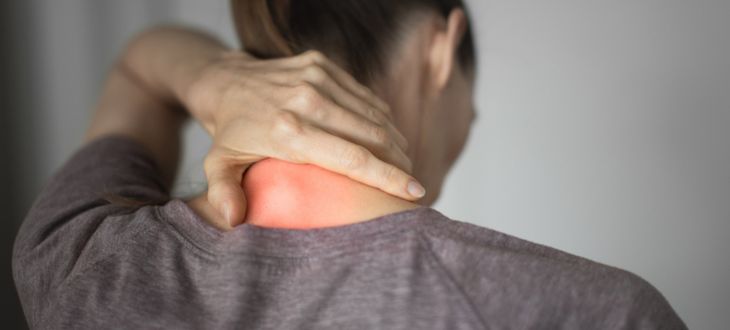
Neck pain (cervicalgia) stems from the muscles, ligaments, disks, and facet joints of the cervical spine. Because this region also houses the spinal cord and major nerve roots, knowing when to seek care is critical. Common causes include:
- Postural strain (“tech neck”): Forward-head posture during screen use compresses cervical joints and overloads extensors.
- Degenerative disk disease / osteoarthritis: Age-related loss of disk height and cartilage integrity. See our overview of common causes of neck pain.
- Facet joint dysfunction: Restricted joint mobility producing localized pain and cervicogenic headache.
- Acute soft-tissue injury: Whiplash or impact trauma. See our guide on acute neck pain.
Most minor cases respond to conservative care within 7–14 days. The key question is when symptoms signal something structural or neurological.
When Should I Worry About Neck Pain?
Seek medical evaluation if pain follows a traumatic injury, persists beyond six weeks, or is accompanied by numbness, tingling, or weakness in the arms. Constant pain that does not change with position is also a key indicator.
When to Seek Medical Evaluation
Seek evaluation promptly if any of the following apply:
- Pain follows acute trauma
- Symptoms persist beyond 4–6 weeks without improvement
- Pain is constant and position-independent
- Numbness, tingling, or weakness is present in the arms
- Pain interrupts sleep or is accompanied by fever
The distinction between mechanical pain (varies with movement) and neurological pain (radicular symptoms, motor deficits) is the primary diagnostic differentiator. A 2024 systematic review in the Archives of Physiotherapy identified 114 red flags across 29 clinical guidelines, reinforcing the need for structured screening.
Can Neck Pain Be a Sign of Something Serious?
Yes, neck pain can indicate serious structural or neurological issues like cervical myelopathy (spinal cord compression), meningitis, or vascular emergencies. These conditions often present with “red flags” like fever, grip weakness, or sudden “thunderclap” headaches.
Serious Conditions Associated with Neck Pain
Neck pain can indicate conditions beyond muscle strain:
- Cervical radiculopathy: Nerve root compression producing arm pain, paresthesia (pins and needles), and motor weakness. See the StatPearls clinical review (NCBI, updated 2023).
- Cervical myelopathy: Spinal cord compression causing progressive limb dysfunction — a surgical emergency when cord signal change is present. See the StatPearls review on myelopathy (NCBI, updated 2023).
- Spinal stenosis: Canal narrowing presenting with diffuse arm symptoms and gait instability.
- Meningitis: A serious infection that must be excluded when fever and nuchal rigidity (extreme neck stiffness) coexist.
- Vascular emergencies: Cervical artery dissection or subarachnoid hemorrhage can present as sudden, severe neck pain requiring immediate imaging.
Neck Pain Red Flags
1. Radicular Pain and Paresthesia
Electric-shock pain or persistent tingling radiating into the shoulder, arm, or fingers indicates nerve root irritation. This typically occurs in the lower neck (C5–C7 vertebrae), which contains the nerves that control shoulder, arm, and hand movement.
2. Upper Extremity Weakness
Grip weakness or loss of fine motor control (dropping objects, difficulty buttoning shirts) are hallmarks of cervical myelopathy. MRI is the standard of care. Do not delay evaluation.
3. Pain Refractory to Conservative Care
No improvement after 4–6 weeks of rest, anti-inflammatories, and physical therapy suggests structural pathology requiring advanced imaging and targeted intervention.
4. Fever with Nuchal Rigidity (Severe Stiffness)
If you experience a severe headache, fever, and an inability to touch your chin to your chest, this is presumptive meningitis. Activate emergency services immediately.
Diagnosis and Treatment
Accurate diagnosis drives effective care. For a full overview of available procedures, visit our spinal treatments page. Our approach includes:
- Advanced imaging: Digital X-ray and MRI to evaluate disk height, nerve space, and cord integrity.
- Cervical epidural steroid injections: Targeted corticosteroid delivery to reduce perineural inflammation.
- Facet joint injections / medial branch blocks: Diagnostic and therapeutic relief for facet arthrosis.
- Trigger point injections: Local anesthetic for myofascial pain generators referring to the head or interscapular region.
- Physical therapy: Postural retraining and cervical stabilization to prevent recurrence.
When to Go to the ER
Go to the emergency department immediately if you have:
- Neck pain following high-impact trauma
- A sudden “thunderclap” headache (the worst headache of your life) along with neck pain.
- New bladder or bowel dysfunction alongside neck symptoms
- Rapidly progressive arm or leg weakness
Don’t Let Neck Pain Limit Your Life
You don’t have to “just live” with chronic stiffness or radiating pain. Our specialists focus on identifying the root cause of your discomfort to help you avoid invasive procedures.
Ready to find relief? Call us today at (386) 255-4596 or Book Your Consultation Online to start your structured path to recovery.